If you can’t find the answer to your specific question, don’t hesitate to contact us via the contact form or send an email to info@dykarnslabradoodle.se
Are Labradoodles hypoallergenic?
Research conducted to find hypoallergenic breeds has shown that differences are significantly greater between individuals than between breeds. Several Labradoodle breeders have tested entire litters, and even among full siblings, allergen levels vary greatly. Therefore, having met one or more Labradoodles without experiencing allergic reactions is no indication that you will tolerate the Labradoodle you acquire in the future. The fact that they still suit many allergy sufferers is partly due to most of them not shedding, but the main reason is that their coat is well-suited for regular bathing, which reduces allergens in the fur. This applies to all non-shedding breeds, such as poodles, and is not unique to Labradoodles. If you are an allergy sufferer acquiring a puppy, you should be aware that there can be differences between individual dogs and that it often takes up to six months for a dog to develop its adult coat. We cannot sell puppies with an open purchase option but apply the Swedish Kennel Club’s (SKK) rules on repurchases. If you are curious to read more about hypoallergenic dogs, click HERE (where Thilde Höök guest blogs on the topic for Allergenius, who, among other things, developed an allergen test for dogs).
Are health tests performed on the dogs you use for breeding?
Both Labradors and Poodles can have hip problems. To minimize the risk of our offspring suffering from hip issues in the future, we X-ray the hips and elbows of our breeding dogs. The dogs we use for breeding come from kennels that have long only used dogs with the best results on all health tests. We encourage all our puppy buyers to X-ray their dog’s hips and, of course, only use dogs with faultless hips and elbows in our own breeding.
How much does a Labradoodle cost?
A puppy from us costs 40,000-50,000 SEK including VAT. Generally, smaller sizes cost more, and the same applies to puppies conceived through imported frozen semen. The price does not differ between males and females.
What type of coat is typical for a Labradoodle?
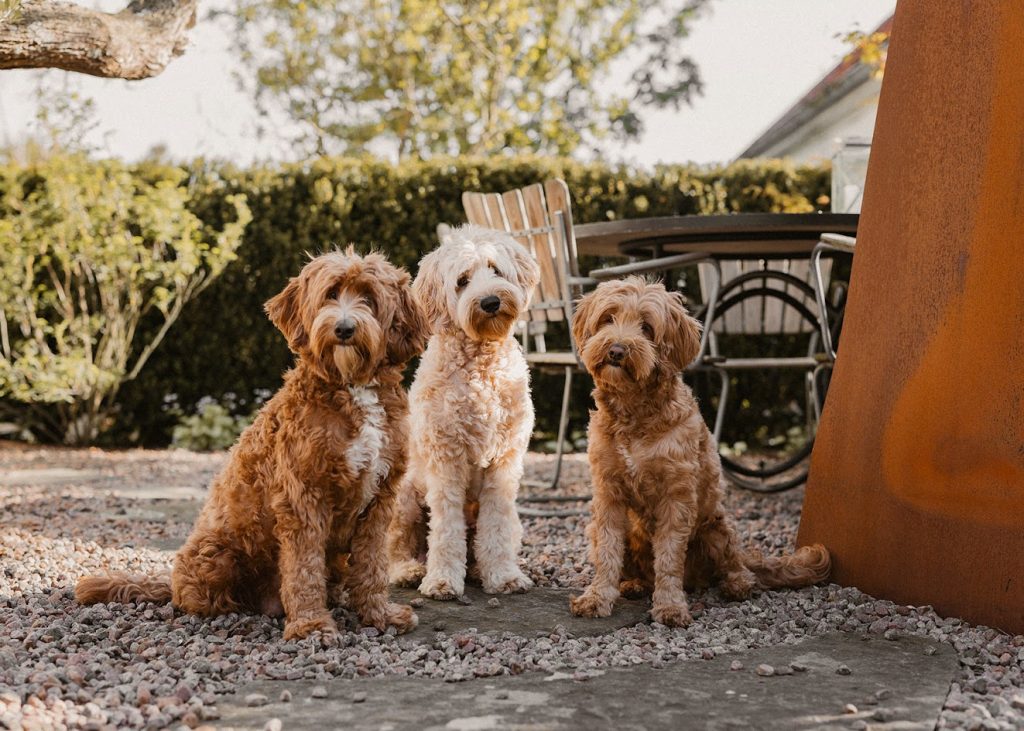
Our breeding goal is to produce dogs that do not shed and have soft coats with varying degrees of curl. We only use dogs with so-called fleece coats in our breeding. A non-shedding dog must be clipped instead, and the length and style chosen for your dog are entirely up to the owner. The longer the coat you choose for your dog, the more time you should be prepared to spend on coat care. It is appropriate to clip the dog approximately every 3-4 months.
How big is a Labradoodle?
The size of Labradoodles varies, but the largest ones are slightly taller than a Labrador but significantly lighter in body. Generally, males are slightly larger than females. There are three size classifications:
Standard: Withers height between 53 – 71 cm and approximate weight: 18 – 25 kg
Medium: Withers height between 43 – 53 cm and approximate weight: 14 – 18 kg
Miniature: Withers height between 30-43 cm and approximate weight: 7 – 12 kg.
We only breed dogs of medium and miniature size.
How much exercise and training does a Labradoodle need?
Regular exercise and mental stimulation are necessary to have as harmonious and pleasant a dog as possible. However, regular exercise should not be interpreted as “lots of exercise,” especially for a young dog. Play with other dogs and toys must be limited as puppies don’t always know when they are tired (just like small children). It is also good to avoid too much climbing, stairs, and similar activities that put a heavy strain on the rapidly growing skeleton. You should wait until the dog is fully grown before taking it on bike rides or jogs. They are often very athletic dogs and are well-suited for agility, as well as freestyle, obedience, tracking, and trick training. Most of them like water and are good swimmers. We recommend all puppy buyers to attend a puppy class with their dog to get help setting up the initial training and also to accustom the dog to meeting other dogs. The training during the initial period lays the foundation for a compliant and harmonious dog, and from puppy class, you can get many tips on how to train independently at home. Participating in a puppy class has another great advantage for those who have bought a Labradoodle: you will most likely get even more proof of what an incredibly pleasant and easy-to-train dog you have acquired.
What colors can a Labradoodle have?
All colors found in Poodles and Labradors are found in Doodles, and we breed them all. Puppies from us can be black, brown, red, caramel, apricot, cream-colored, and bi-colored dogs.
Most of the time, there are many different colors in each litter, and it is not uncommon for them to be completely different from their parents, so it is always exciting to see what colors they will have. Regardless of color, every single one is equally wonderful, of course!
Do you want to know more about Labradoodles?
We have a close collaboration with the Pomonadalens Labradoodle kennel, and on their page About Labradoodles, you can find some history and other facts about these lovely, curly dogs. Click HERE to go there (the page opens in a new window).